 0755-23179541
 sales@oyii.net
 8618926041961
High-Performance LAN Cabling for Transceiver Interfacing
Commercial & Industrial Paradigm: Optical Distribution in Modern LAN Networks
The exponential expansion of bandwidth requirements across modern enterprise ecosystems has triggered a monumental migration from traditional copper structured cabling (Cat6/Cat6A) toward ubiquitous fiber-to-the-desktop (FTTD), campus optical aggregation, and active optical LAN (POL/GPON/EPON) architectures. Central to this transformation is the deployment of dedicated Optical Distribution Boxes (ODBs) tailored specifically for bridging backbone trunk fibers with local area network optical transceiver modules, including SFP+, SFP28, QSFP28, and emergent 400G-SR4/FR4 optical engines.
In legacy environments, optical distribution was predominantly restricted to main equipment rooms (MER) and intermediate distribution frames (IDF). However, modern software-defined enterprise environments, high-performance edge computing nodes, AI training clusters, and automated manufacturing facilities require physical cross-connect terminals to be distributed directly within active floor zones. The Optical Distribution Box serves as the quintessential protective demarcation, transition, and routing apparatus, safeguarding critical optical links against micro-bending, optical attenuation, airborne contaminants, and manual patch stress.
Transceiver-Centric Physical Layer Demarcation
Modern pluggable optical transceivers operate within stringent optical loss budgets (often under 1.5 dB to 3.0 dB in multimode OM4/OM5 25G-100G links). An Optical Distribution Box guarantees minimum insertion loss through high-precision LC, SC, or MPO/MTP adapter alignments, maintaining the signal integrity required by sensitive digital diagnostic monitoring (DDM) transceivers.
Scalability and Multi-Rate Migration Path
Industrial campuses are rapidly evolving toward heterogeneous multi-rate transceivers (1G/10G/25G/40G/100GbE). High-density modular distribution boxes enable network administrators to swap front adapter plates without disturbing trunk cable splices, allowing frictionless transition from duplex LC connectors to 8-fiber or 12-fiber parallel optics transceivers.
Technical Topologies: LAN Optical Transceiver Connectivity Architecture
Integrating Optical Distribution Boxes into Local Area Network transceiver topologies necessitates strict adherence to optical power budget calculations, dispersion limits, and bend-radius mitigation. When an optical transceiver converts high-speed electrical signals into serial optical pulses (via VCSEL or DFB lasers), mechanical stability within the distribution interface is non-negotiable.
Direct Equipment Interconnect vs. Cross-Connect Architecture
Within commercial network zones, direct point-to-point connections between top-of-rack (ToR) transceivers and end terminals create unmanageable cable sprawl, elevating the risk of accidental transceiver port damage during maintenance. By implementing an Optical Distribution Box as a structured cross-connect node:
1. Stress Decoupling: Heavy incoming outdoor or riser multi-core loose-tube cables terminate onto internal fusion splice trays or break-out cassettes. Sensitive equipment patchcords link transceivers to the front-facing bulkhead adapters, entirely insulating the structural cabling from mechanical movement.
2. Optical Cleanliness Zone: Pluggable optical transceivers are highly susceptible to dust contamination on the ferrule endface. Modern distribution boxes incorporate integrated dust covers, sealed rubber entry grommets, and dedicated patchcord routing lanes that maintain cleaner interface mating conditions.
3. Polarity and Channel Assignment: In parallel optics configurations (e.g., QSFP+ to 4x SFP+ break-out transceivers), internal routing within the distribution box manages Type-A, Type-B, or Type-C polarity configurations, ensuring Tx/Rx alignment remains mathematically and physically error-free across complex switching matrices.
Industrial and Harsh-Environment LAN Endpoints
In intelligent manufacturing, oil & gas, and outdoor surveillance networks, transceivers operate within industrial Ethernet switches subjected to thermal cycling, electromagnetic interference (EMI), and ambient vibrations. Ruggedized optical distribution boxes provide IP65/IP68 ingress sealing and impact-resistant casings, shielding optical connections from ambient debris and moisture.
Emerging Trends: AI-Driven Workloads and High-Density Distribution Evolution
As artificial intelligence compute clusters, Wi-Fi 7 access point rollouts, and multi-gigabit campus switches saturate traditional link budgets, the optical distribution landscape is evolving rapidly across three distinct technological vectors:
Ultra-High Density and Small Form Factor Connectors: Traditional LC and SC connectors are increasingly complemented by VSFF (Very Small Form Factor) interfaces, such as CS, SN, and MDC connectors. These allow future-ready Optical Distribution Boxes to multiply port densities by up to 300% in identical rack-unit (RU) or wall-mount footprints, matching the rapid emergence of multi-port multi-wavelength transceiver interfaces.
Passive Optical LAN (POL) Integration: Enterprise IT is progressively adopting Passive Optical LAN architectures to reduce power consumption and cooling demands in alignment with global carbon-neutrality initiatives. Optical Distribution Boxes housing integrated PLC splitters allow single-mode trunk transceivers at the Optical Line Terminal (OLT) to broadcast efficiently across hundreds of Optical Network Units (ONUs) throughout multiple commercial campus zones.
Modular Pre-Terminated MPO/MTP Plug-and-Play Cassettes: To eliminate labor-intensive field termination errors and minimize deployment cycles, distribution boxes are standardizing on pre-terminated, factory-certified fiber harnesses. This transition dramatically enhances network uptime, ensuring return loss performance exceeding 55dB (APC) and insertion losses below 0.35dB across full optical transmission pathways.
Oyi international ., Ltd. - Global Optical Engineering Pioneer
Oyi international., Ltd. is a dynamic and innovative fibre optic cable company based in Shenzhen, China. Since its inception in 2006, OYI has been dedicated to providing world-class fibre optic products and solutions to businesses and individuals across the globe. Our Technology R&D department has more than 20 specialized staff committed to developing innovative technologies and providing high-quality products and services. We export our products to 143 countries and have established long-term partnerships with 268 clients.
Our products are widely used in telecommunications, data center, CATV, industrial and other areas. Our main products include various types of optical fiber cables, fiber optic linkers, fiber distribution series, fiber optic connectors, fiber optic adapters, fiber optic couplers, fiber optic attenuators, and WDM series. Not only that, our products cover ADSS, ASU, Drop Cable, Micro Duct Cable, OPGW, Fast Connector, PLC Splitter, Closure, FTTH Box, etc. In addition, we provide our customers with complete fiber optic solutions, such as Fiber to the Home (FTTH), Optical Network Units (ONUs), and High Voltage Electrical Power Lines. We also provide OEM designs and financial support to help our customers integrate multiple platforms and reduce costs.
-
20Years in The Industry Sector
-
20+Technical R&D Personnel
-
143Exporting Countries Served
-
268Global Cooperative Clients
About Oyi: State-of-the-Art Production & Testing Facilities


Company Philosophy & Our Factory Standards
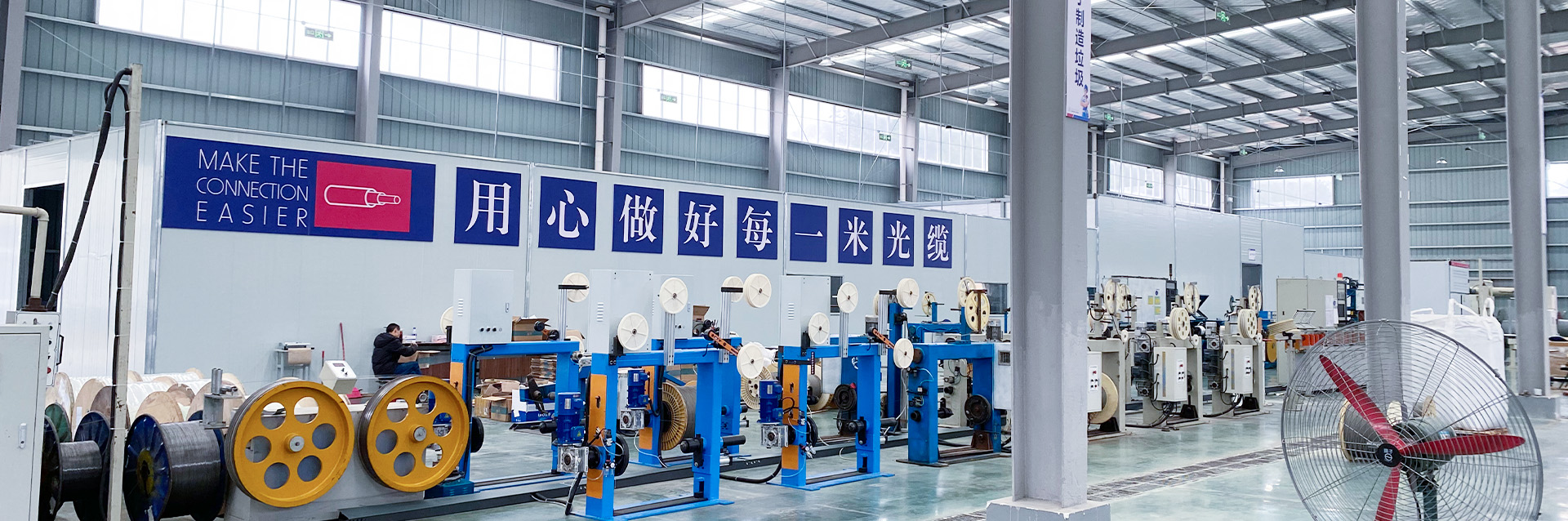
We are committed to innovation and excellence. Our team of experts are constantly pushing the boundaries of what’s possible, ensuring that we remain at the forefront of the industry. We invest heavily in research and development to ensure that we are always one step ahead of the competition. Our cutting-edge technology allows us to produce fibre optic cables that are not only faster and more reliable, but also more durable and cost-effective.
Our advanced manufacturing process ensures that our fibre optic cables are of the highest quality, guaranteeing lightning-fast speeds and reliable connectivity. Our commitment to excellence means that our customers can always rely on us to provide them with the best possible solutions. If you’re looking for a reliable, high-speed fibre optic cable solution, look no further than OYI. Contact us now to see how we can help you stay connected and take your business to the next level.
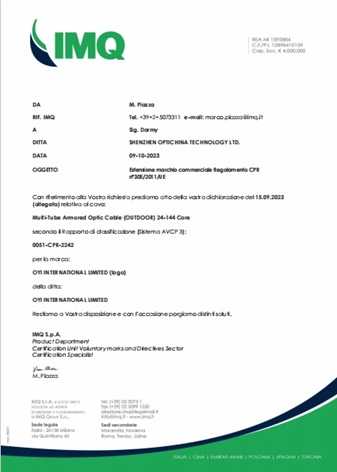
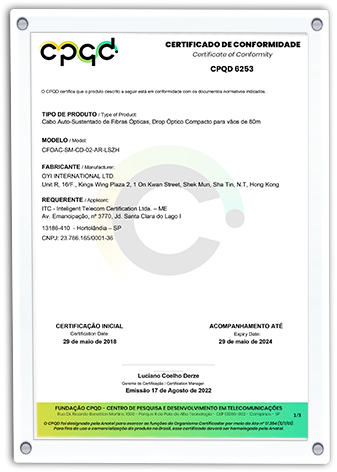
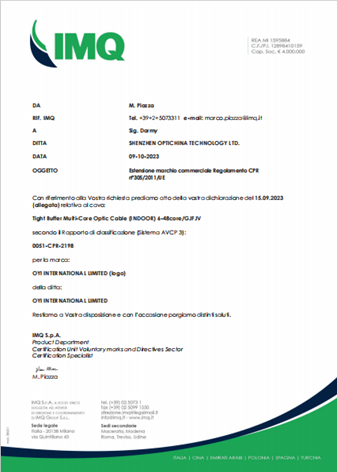
The Company Has Obtained International Certification



End-to-End Optical Distribution & Transceiver Interfacing Portfolio