 0755-23179541
  sales@oyii.net
.png) 8618926041961
8618926041961Featured Signal Distribution & Termination Solutions
Optimizing Long-Distance Fiber-to-Copper Media Converter Signal Conversions via MPO Patchcord Optics
In the rapidly evolving landscape of telecommunications, industrial automation, and enterprise networking, the demand for bandwidth and transmission distance has reached unprecedented levels. Modern network architectures are increasingly characterized by hybrid infrastructures where high-speed fiber optic backbones must interface seamlessly with legacy or localized copper Ethernet networks. At the heart of this convergence are fiber-to-copper media converters, devices that translate optical signals into electrical impulses and vice versa. However, as the density of these conversion nodes increases, traditional simplex or duplex fiber patching methods become bottlenecked. This is where MPO (Multi-Fiber Push-On) patchcord optics step in to redefine performance, scalability, and structural efficiency in long-distance signal conversions.
MPO connectors bundle 8, 12, 16, 24, or even 48 fibers into a single interface. By consolidating multiple optical channels, MPO patchcords allow high-density media converter chassis to receive high-volume data streams over long distances, using minimal physical space. This is critical for data centers and metropolitan area networks (MANs) where space and cable management are premium constraints.
Industrial & Commercial Status of Fiber-to-Copper Signal Conversions
Historically, copper wiring (such as Cat5e, Cat6, and Cat6a) has been the standard for local area networks (LANs) and industrial fieldbus applications due to its cost-effectiveness and ease of deployment. However, copper's physical limitation restricts its transmission distance to approximately 100 meters at Gigabit speeds. In industrial environments—such as mining, oil and gas, smart manufacturing plants, and sprawling municipal surveillance systems—devices are often separated by kilometers.
To bridge these vast distances, fiber optic cables are deployed to carry signals across kilometers without degradation. At the destination, media converters translate these optical signals back to copper-based Ethernet to connect to local switches, IP cameras, PLCs (Programmable Logic Controllers), or user terminals. Currently, the commercial market is witnessing a massive surge in multi-port media converter chassis deployments. Instead of using isolated single-channel converters, enterprises are consolidating dozens of conversion modules into centralized 19-inch racks. This consolidation demands a high-density optical patching solution, making MPO patchcords the industry standard for clean, scalable, and low-loss fiber distribution to these converter banks.
Deep Dive: The Role of MPO Patchcords in Long-Distance Transmission
Long-distance optical transmission requires single-mode fiber (SMF) configurations (typically OS2) to minimize attenuation over distances ranging from 10 km to 120 km. MPO patchcords utilize precision-molded MT ferrules to align multiple fibers simultaneously. When interfacing with a fiber-to-copper media converter system, the MPO patchcord acts as the high-speed optical highway. The signals are routed from a central switch via an MPO trunk, broken down using MPO-to-LC harness cables or transition modules, and then plugged directly into the SFP (Small Form-factor Pluggable) transceivers of the media converters.
This architecture offers several distinct technical advantages:
- Reduced Insertion Loss: High-quality MPO patchcords feature low-loss ferrules, ensuring that the optical budget is preserved over long-distance links. This is vital for media converters operating at the edge of their optical receiver sensitivity.
- Polarity Management: Maintaining the correct transmit-to-receive (Tx/Rx) path across long distances is simplified using standardized MPO polarity methods (Type A, B, or C), minimizing configuration errors during deployment.
- Rapid Deployment: Pre-terminated MPO patchcords eliminate the need for field splicing, reducing installation time by up to 75% at conversion hubs.
Key Application Scenarios
1. Smart City Surveillance and Intelligent Transportation Systems (ITS)
Municipalities deploy thousands of IP cameras and traffic sensors across vast urban areas. These edge devices typically run on copper PoE (Power over Ethernet). Fiber-to-copper media converters are placed in outdoor enclosures near the cameras, converting the copper signal to fiber. The return signals from various sectors of the city converge at a central monitoring station. Here, high-density MPO patchcords route the incoming multi-fiber lines directly into central media converter chassis, ensuring real-time, low-latency video transmission back to the control servers.
2. Industrial Automation and Harsh Manufacturing Environments
Heavy machinery and high-voltage systems generate massive electromagnetic interference (EMI) that degrades copper signals. Optical fiber is immune to EMI. Factories use fiber to link remote control rooms with shop-floor machinery. Media converters at the machine level convert the signals to copper for PLC connections. MPO patchcords run through the factory's main cable trays, providing a rugged, high-density, and EMI-immune backbone that connects multiple production lines to the central IT stack.
3. Enterprise Campus Networks & Broad-Scale Connectivity
University campuses, corporate parks, and hospital complexes consist of multiple buildings spread over large geographic areas. While internal building networks are often copper-based, the inter-building connections are optical. Media converters are deployed at the entry point of each building. MPO patchcords enable the consolidation of multiple inter-building links into a single, easily managed patch panel, simplifying routing to the core enterprise switches.
Future Trends in Fiber-to-Copper Signal Conversions
As network speeds transition from 10G to 40G, 100G, and even 400G/800G, the physical layer must adapt. The future of media conversion lies in intelligent, managed media converters that support higher bandwidths and advanced diagnostics (such as Link Fault Pass-Through and OAM). Consequently, MPO patchcords are evolving to support higher fiber counts and lower insertion losses. The integration of MTP/MPO connectors with built-in polarity and gender-changing capabilities is becoming standard, offering unmatched flexibility in dynamic network topologies. Furthermore, the push towards green data centers is driving the development of ultra-low power media converters, which, when paired with high-density MPO cabling, significantly reduce the overall thermal and spatial footprint of network distribution hubs.
Oyi International Co., Ltd. - Leading Global Fiber Optic Innovation
Oyi international., Ltd. is a dynamic and innovative fibre optic cable company based in Shenzhen, China. Since its inception in 2006, OYI has been dedicated to providing world-class fibre optic products and solutions to businesses and individuals across the globe. Our Technology R&D department has more than 20 specialized staff committed to developing innovative technologies and providing high-quality products and services. We export our products to 143 countries and have established long-term partnerships with 268 clients.
Our products are widely used in telecommunications, data center, CATV, industrial and other areas. Our main products include various types of optical fiber cables, fiber optic linkers, fiber distribution series, fiber optic connectors, fiber optic adapters, fiber optic couplers, fiber optic attenuators, and WDM series. Not only that, our products cover ADSS, ASU, Drop Cable, Micro Duct Cable, OPGW, Fast Connector, PLC Splitter, Closure, FTTH Box, etc. In addition, we provide our customers with complete fiber optic solutions, such as Fiber to the Home (FTTH), Optical Network Units (ONUs), and High Voltage Electrical Power Lines. We also provide OEM designs and financial support to help our customers integrate multiple platforms and reduce costs.
About Oyi - Production & Application Gallery


Company Philosophy & Our Factory
We are committed to innovation and excellence. Our team of experts are constantly pushing the boundaries of what’s possible, ensuring that we remain at the forefront of the industry. We invest heavily in research and development to ensure that we are always one step ahead of the competition. Our cutting-edge technology allows us to produce fibre optic cables that are not only faster and more reliable, but also more durable and cost-effective.
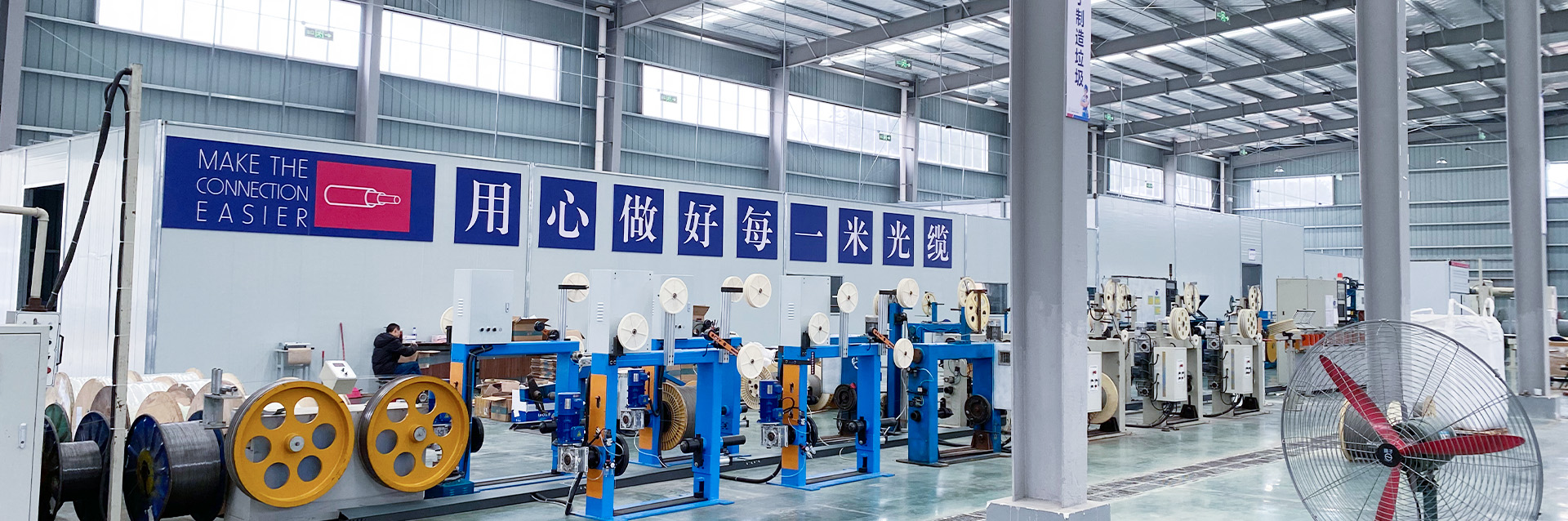
Our advanced manufacturing process ensures that our fibre optic cables are of the highest quality, guaranteeing lightning-fast speeds and reliable connectivity. Our commitment to excellence means that our customers can always rely on us to provide them with the best possible solutions.
If you’re looking for a reliable, high-speed fibre optic cable solution, look no further than OYI. Contact us now to see how we can help you stay connected and take your business to the next level.
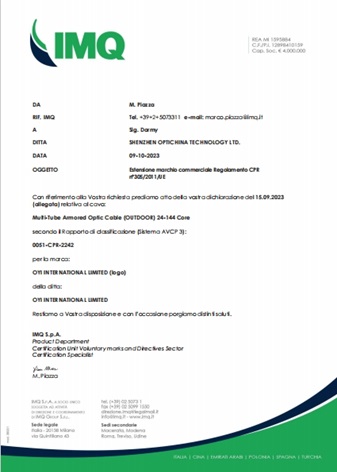
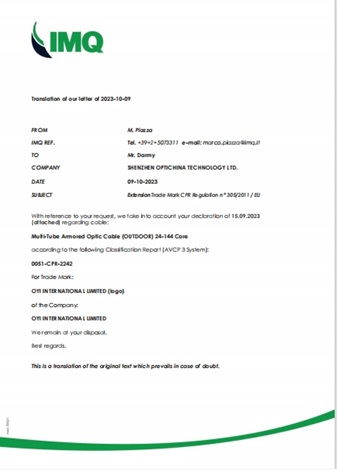
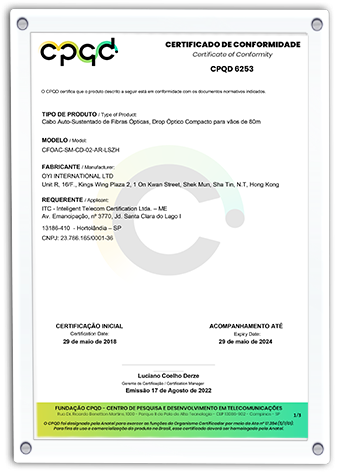
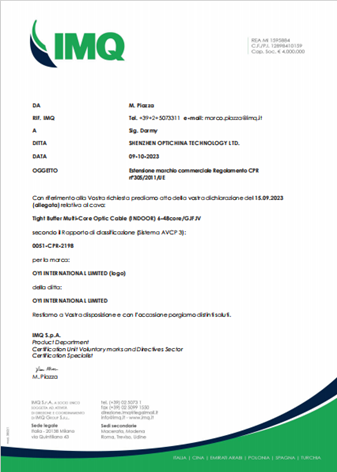
The Company has Obtained Certification